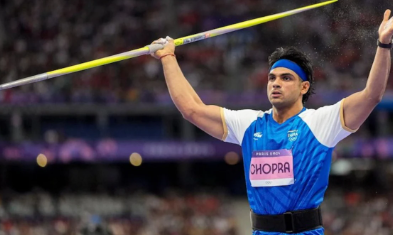
Summary – Following a stellar Diamond League runner-up finish, Neeraj Chopra is primed to challenge European rival Julian Weber at the upcoming World Athletics Championships in Tokyo.,
Article –
Neeraj Chopra’s emphatic performance at the recent Diamond League has set the stage for an exciting showdown at the World Athletics Championships in Tokyo. His runner-up finish has raised anticipation for a thrilling duel against European rival Julian Weber.
Setting the Stage
The World Athletics Championships, a pinnacle event drawing elite global athletes, follows the Olympics and holds significant importance. Neeraj Chopra, the Indian javelin thrower and Olympic gold medalist, has shown consistent performance and technique refinement throughout the 2025 season. His strong showing at the Diamond League—a premier annual athletics competition—secured him the runner-up position in the javelin throw, bolstering his credentials ahead of the Tokyo championships.
Adille Sumariwalla, president of the Athletics Federation of India, has publicly endorsed Chopra’s potential, highlighting his physical conditioning, psychological resilience, and strategic approach as key advantages in the upcoming competition.
The Turning Point
Chopra’s 2025 campaign hit a high with his runner-up finish at the Diamond League final, where he achieved a new personal best after fine-tuning his run-up mechanics for optimal balance and release velocity. This performance reaffirmed his status among the world’s leading javelin throwers and sent a clear message to competitors like Germany’s Julian Weber, who claimed first place in the event.
The rivalry between Chopra and Weber promises to be tactically intriguing, with both athletes showcasing contrasting styles:
- Neeraj Chopra: Explosive power combined with smooth technique focused on aerodynamic optimization of the javelin release.
- Julian Weber: Consistency and adaptability to varying wind conditions, a crucial factor in outdoor competitions.
Tactical and Technical Breakdown
Success in javelin throw hinges on multiple factors such as release velocity, angle, and the aerodynamics of the javelin itself. Chopra’s refined technique targets an ideal release angle between 36-38 degrees, aimed at maximizing flight distance. His rapid approach run translates kinetic energy into powerful throws.
Advanced biomechanical analysis has been integrated into Chopra’s training, enhancing his flexibility and explosiveness—both vital for sustaining high performance under pressure.
In contrast, Julian Weber emphasizes environmental adaptability and precise timing, adjusting his run-up to cope with wind changes and maintaining release efficiency. His extensive experience in European championships provides him with deep insight into managing event conditions strategically.
Psychologically, Chopra’s Olympic success has fostered a strong winning mindset, though it also brings increased expectations. Sumariwalla notes **Chopra’s mental toughness and focus** as crucial for championship readiness, traits he has demonstrated consistently.
Reactions from the Sport
The global athletics community has enthusiastically welcomed this rivalry. Chopra’s rise is particularly notable as it challenges traditional javelin powerhouses and represents a breakthrough for India in field events.
Experts highlight that such international duels:
- Elevate the sport’s profile.
- Encourage investment in athlete development.
- Spur innovation in training and equipment.
Federations, sponsors, and equipment manufacturers are closely observing Chopra’s technique, considering custom enhancements to aid his throws. Coaches across nations express mutual respect, acknowledging the demanding physical and technical standards required at this level.
The competition will adhere to World Athletics regulations, including standardized javelin specifications and strict anti-doping protocols to ensure fair play and athlete safety.
What Comes Next?
As the championships approach, anticipation builds for the defining encounter between Neeraj Chopra and Julian Weber in the men’s javelin throw. Beyond deciding the gold medalist, this event is expected to influence future coaching, athlete preparation, and inspire upcoming generations of javelin throwers worldwide.
The outcome remains uncertain given the contrasting strengths: will Chopra’s power and refined technique secure victory, or will Weber’s consistency and adaptability prevail under Tokyo’s conditions? This rivalry could spark a strategic evolution in javelin throwing globally.
Fans and analysts alike will watch closely to see how these athletes impact rankings, sponsorship opportunities, and the narrative of the sport in future World Athletics competitions.
Stay tuned to SPACE SPORTS for continuing worldwide sports insights.
About The Author


More Stories
Inside FIFA’s Budget Cuts Ahead of the 2026 World Cup: What It Means for the Tournament
The Historic Sibling Debut at the FIG Apparatus World Cup in Antalya
Sanju Samson’s Rise and Rohit Sharma’s Leadership: The Dynamic Duo Behind India’s T20 World Cup 2026 Triumph